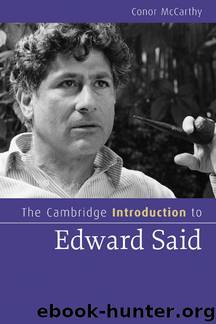
The Cambridge Introduction to Edward Said by Conor McCarthy
Author:Conor McCarthy [Conor McCarthy]
Language: eng
Format: epub, mobi
Published: 0101-01-01T00:00:00+00:00
However, Said also wishes to stress that his book is not an exercise in the history of ideas, conventionally conceived. Orientalist writings – from philological treatises to Romantic travel narratives to policy reports – do not exist in a realm of pure ideality. Rather, and in this Said is following Foucault, the point of Orientalism is to argue that these ideas, these texts, this discourse possess a weight and force, an effectiveness, a durability and worldly presence of their own.
Said deviates from Foucault in respect of the relationship of individual authors to the discourse. For Foucault, a discourse is a system of linguistic rules and protocols that govern what it is possible to say or write in a specific field. The individual author, for Foucault, will always be subsumed within this wider system: his or her work will always be shaped, channelled, and finally restricted by the order of discourse. But Said declares that he does believe ‘in the determining imprint of individual authors upon the otherwise anonymous collective body of texts constituting a discursive formation like Orientalism’.45 For example, great nineteenth-century writers such as Gérard de Nerval, Gustave Flaubert, and Richard Burton all read and cited the work of Edward Lane. Lane's works lent their authority to those who learned from him and came after him. In this way his work became more than itself: in Said's words, it acquired ‘mass, density, and referential power’. Yet Lane's own personal style was important, and contributed to his very currency.
Said also stresses the personal aspect to his writing of Orientalism. This is a way that his ideas about beginnings can be seen to have implications for an individual writer, and in fact for the theorist of beginnings himself. Nonetheless, as with the use of the idea of authority, we find here the notion of beginning is given a much more explicitly material and socio-historical inflection than was the case in Beginnings. Said quotes Gramsci:
Download
The Cambridge Introduction to Edward Said by Conor McCarthy.mobi
This site does not store any files on its server. We only index and link to content provided by other sites. Please contact the content providers to delete copyright contents if any and email us, we'll remove relevant links or contents immediately.
| Books & Reading | Comparative Literature |
| Criticism & Theory | Genres & Styles |
| Movements & Periods | Reference |
| Regional & Cultural | Women Authors |
4 3 2 1: A Novel by Paul Auster(12341)
The handmaid's tale by Margaret Atwood(7713)
Giovanni's Room by James Baldwin(7270)
Asking the Right Questions: A Guide to Critical Thinking by M. Neil Browne & Stuart M. Keeley(5720)
Big Magic: Creative Living Beyond Fear by Elizabeth Gilbert(5694)
Ego Is the Enemy by Ryan Holiday(5360)
The Body: A Guide for Occupants by Bill Bryson(5040)
On Writing A Memoir of the Craft by Stephen King(4895)
Ken Follett - World without end by Ken Follett(4691)
Adulting by Kelly Williams Brown(4540)
Bluets by Maggie Nelson(4521)
Eat That Frog! by Brian Tracy(4486)
Guilty Pleasures by Laurell K Hamilton(4398)
The Poetry of Pablo Neruda by Pablo Neruda(4072)
Alive: The Story of the Andes Survivors by Piers Paul Read(4003)
White Noise - A Novel by Don DeLillo(3983)
Fingerprints of the Gods by Graham Hancock(3967)
The Book of Joy by Dalai Lama(3950)
The Bookshop by Penelope Fitzgerald(3818)
